 Cart
Cart
 Sign In
Rule of Thumb: Choose HDPE when you need a stiffer, more dimensionally stable polyethylene for structural parts and wear surfaces. Choose LDPE when you need more flexibility, easier forming, and better impact performance at low temperatures.
HDPE (High-Density Polyethylene)
High-density polyethylene (HDPE) is a semi-crystalline thermoplastic produced via low-pressure polymerization, yielding a tightly packed molecular structure that results in higher density and stiffness compared to other polyethylene grades. With tensile strength typically ranging from 3,000 to 4,500 psi and a density near 0.94-0.97 g/cm³, HDPE provides a strong strength-to-weight ratio. It exhibits broad chemical resistance to solvents, acids, and bases, with very low moisture absorption. Common applications include cutting boards, wear strips, tanks, pipe fittings, and general-purpose fabricated parts requiring dimensional stability under moderate load.
LDPE (Low-Density Polyethylene)
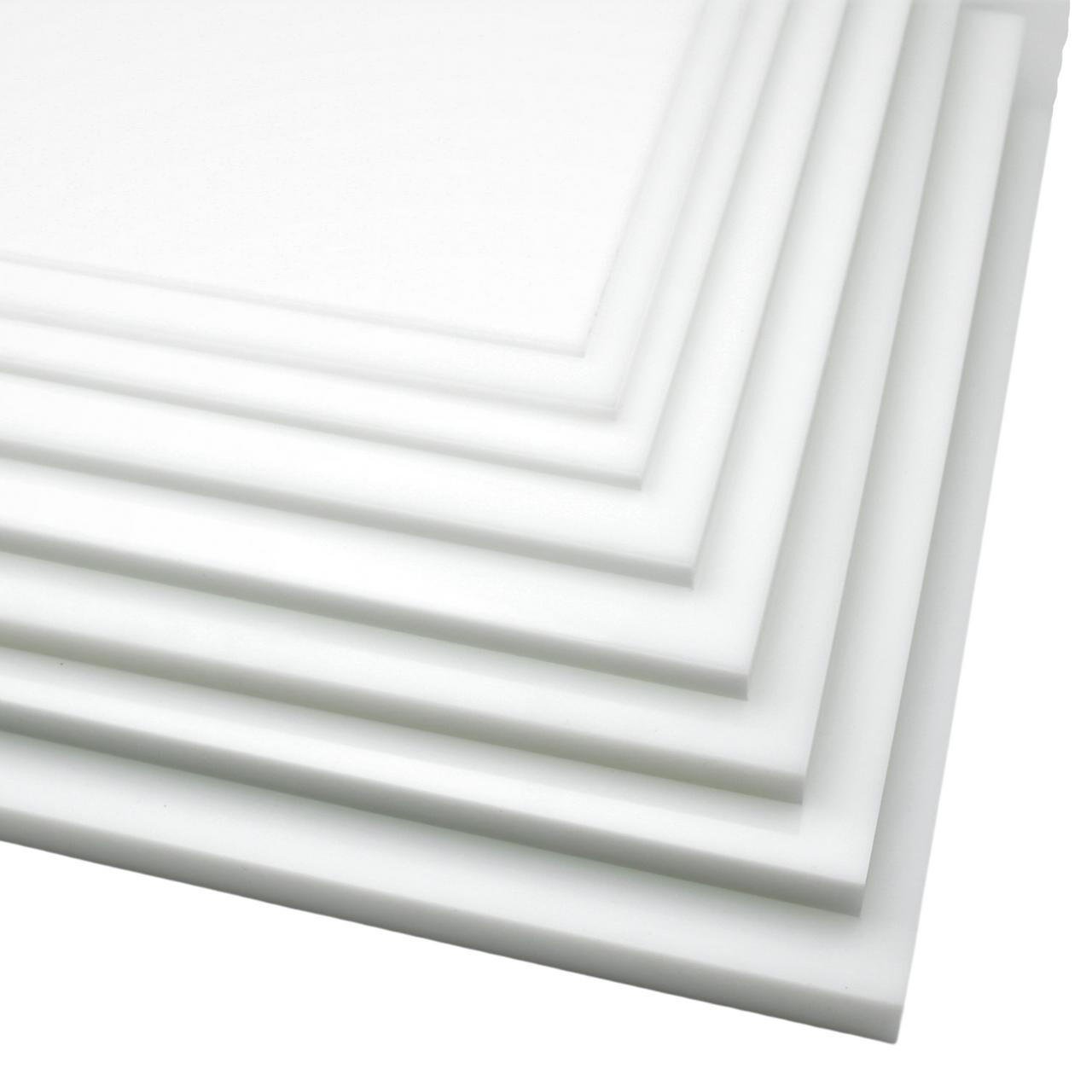
Low-density polyethylene (LDPE) is produced through high-pressure free-radical polymerization, yielding a branched molecular structure that reduces crystallinity and results in a lower-density, more flexible material compared to HDPE. With a density typically between 0.91-0.94 g/cm³ and significantly lower tensile and flexural modulus values, LDPE is well suited for applications requiring repeated flexing, surface conformance, or impact absorption without cracking. It retains toughness at sub-zero temperatures and offers chemical resistance comparable to HDPE. Typical uses include liners, protective sheets, formed parts, and flexible components where the ability to bend or deflect under load is a design requirement rather than a limitation.
HDPE Applications
- Food processing surfaces and cutting boards
- Fabricated chemical and water tanks
- Marine components
- Playground and outdoor components
- Orthotics and prosthetics
- Chute, bin, and tank liners (light duty)
- Welded assemblies and general fabrication
LDPE Applications
- Orthotics and prosthetics (soft, conformable splints)
- Thermoformed and heat-sealed components
- Protective liners and barrier sheets
- Flexible wear parts and pads
- Low-temperature enclosures and housings
LDPE Common Brands
- Denesetec, TECAFINE®
| Characteristic | HDPE | LDPE |
|---|---|---|
| Good chemical resistance | ||
| Low moisture absorption | ||
| Impact resistant | ||
| Easy to weld | ||
| Easy to fabricate | ||
| High stiffness / rigid | ||
| Easy to machine | ||
| Flexible / pliable | ||
| Heat sealable | ||
| Low-temperature toughness |