 Cart
Cart
 Sign In
Differences Between PCTFE and PTFE
PCTFE is a fluoropolymer material with outstanding strength, stiffness, and dimensional stability. It has excellent chemical and radiation resistance and good flammability characteristics. PCTFE has a broad temperature range, good resistance to cold flow, and it has the lowest coefficient of thermal expansion of any unfilled fluoropolymer.
PTFE (polytetrefluoroethylene) is a soft, low friction fluoropolymer with outstanding chemical resistance and weathering resistance. PTFE is stable at temperatures up to 500°F and it is often used in high temperature environments. PTFE also has excellent electrical insulating properties.
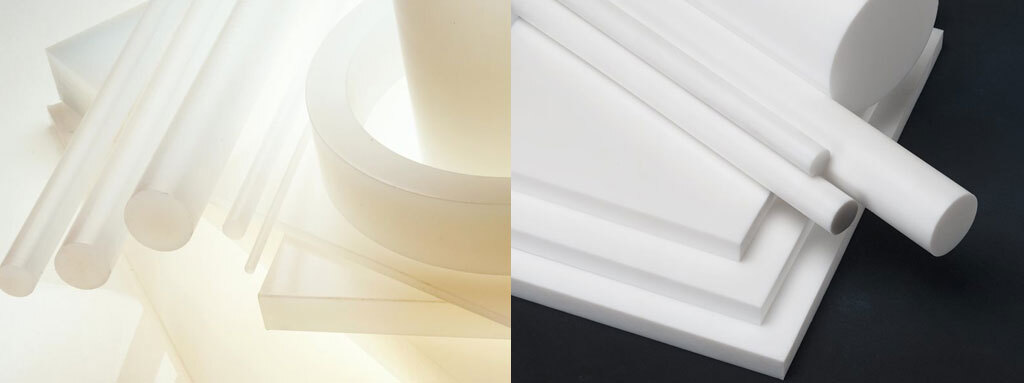
PCTFE Material Characteristics |
PTFE Material Characteristics |
|---|---|
| Excellent chemical resistance Useful temperature range: –400°F to 380°F Dimensionally stable, rigid, and resistant to cold flow Very low gas permeation and outgassing Near zero moisture absorption Radiation resistance |
Outstanding chemical resistance Performs well at elevated temperatures Extremely low friction Soft and formable Good weathering resistance |
PCTFE Applications |
PTFE Applications |
| Seals and gaskets Aerospace valve seats, pump parts, impellers, diaphragms, and plugs Laboratory instruments Cryogenic and chemical processing components Nuclear service/high radiation exposure Liquid oxygen and liquid nitrogen valve lining |
Seals and gaskets Valve and fitting components Pump parts Scientific equipment Chemical resistant tubing Manifolds Semiconductor equipment Bearings and bushings (bearing grades) |
PCTFE Common Brands |
PTFE Common Brands |
| Neoflon®, Kel-F®, Aclon® | Rulon®, Fluorosint® |
Typical Properties of PCTFE vs. PTFE
| Property | Units | ASTM Test | PCTFE | PTFE |
|---|---|---|---|---|
| Specific gravity | – | D792 | 2.11 – 2.17 | 2.15 |
| Water absorption (immersion 24 hours) | % | D570 | 0 | <0.01 |
| Tensile strength | psi | D638 | 4,860 – 5,710 | 1,500 – 3,000 |
| Elongation | % | D638 | 100 – 250 | 100 – 200 |
| Izod impact (notched) | ft-lbs/in | D256 | 2.5 – 3.5 | 3.5 |
| Flexural strength | psi | D790 | 9,570 – 10,300 | – |
| Flexural modulus | psi | D790 | 200,000 – 243,000 | 72,000 |
| Dielectric strength (short term) | V/mil | D149 | 500 | 400 – 500 |
| Coefficient of linear thermal expansion | in/in/°Fx10-5 | D696 | 3.9 | 8.9 |
| Coefficient of friction (dynamic) | – | – | – | 0.1 |
| Maximum continuous service temperature in air | °F | – | 380 | 500 |
| Hardness | scale as noted | D785, D2240 |
Shore D 90 | Shore D 55 |